
MONA GRANITES · 2 MIN READ
From Quarry to Masterpiece: The Journey of Natural Stone Every finished natural stone slab begins as part of the Earth itself.
Long before it becomes a kitchen island, an architectural wall, or a beautifully finished floor, stone passes through several stages of extraction, processing, and craftsmanship.
Understanding this journey reveals the remarkable work behind every finished surface.
Stage 1: Quarrying — Discovering Nature's Raw Material
The journey begins at the quarry, where stone deposits are carefully assessed and suitable blocks are identified for extraction.
Depending on the geological conditions and stone type, specialized cutting and extraction techniques are used to separate blocks from the rock formation.
The objective is to recover usable material while preserving its natural character.
Stage 2: Block Selection
Extracted blocks are assessed for dimensions, colour consistency, visible fissures, natural patterns, and suitability for processing.
Because stone is a natural material, no two blocks are completely identical.
Careful selection helps align the raw material with its intended architectural application.
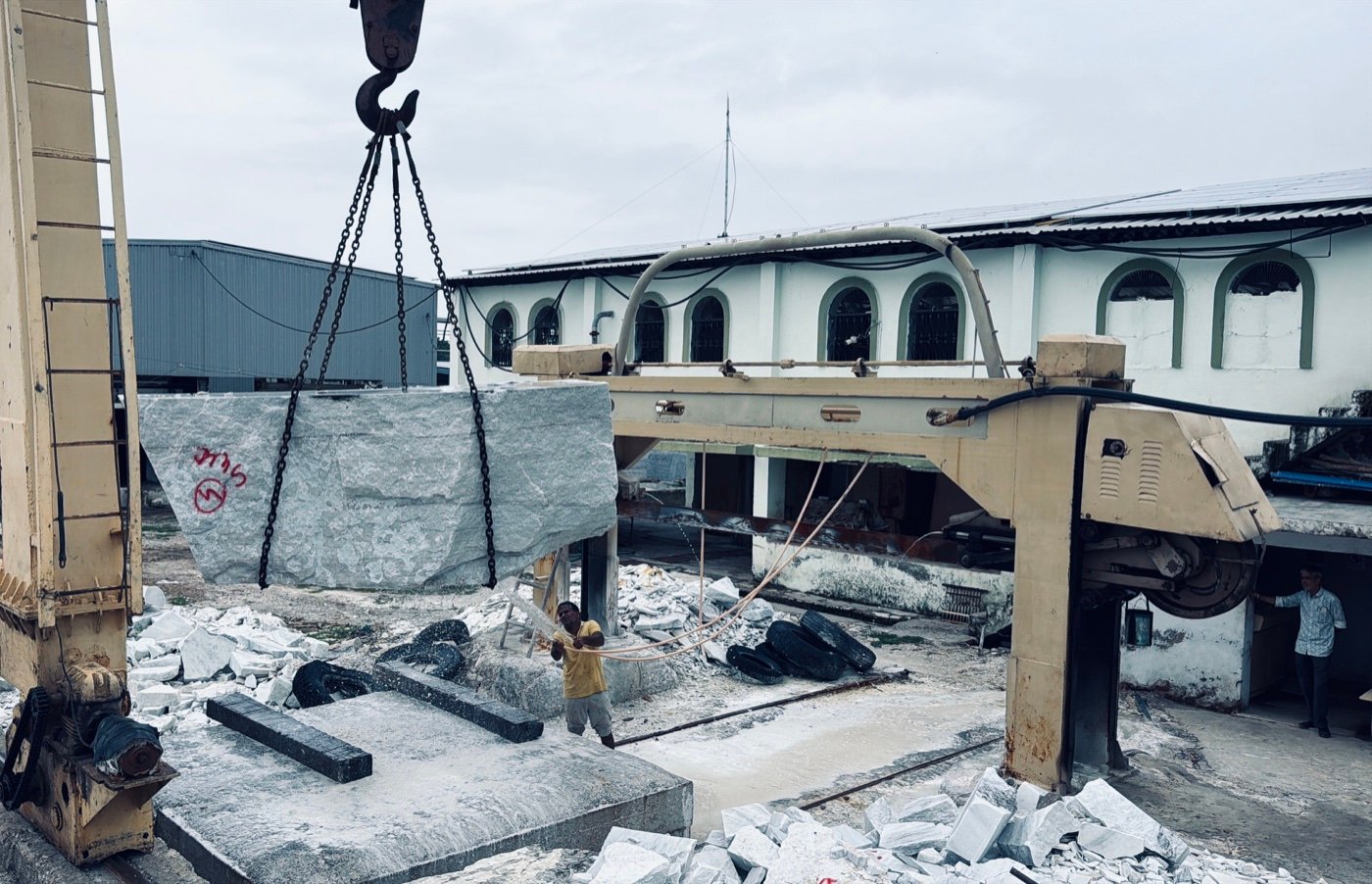
Stage 3: Precision Cutting
Stone blocks are transformed into slabs using industrial cutting equipment, which may include gang saws, diamond wire systems, or other suitable machinery.
Cutting requirements depend on the material, desired thickness, and production specifications.
Stage 4: Surface Processing
After cutting, slabs undergo further preparation and finishing.
Processes may include calibration, grinding, polishing, honing, brushing, or other treatments.
Certain stones may also receive filling or resin treatments where appropriate.
Each process contributes to the final appearance and usability of the stone.
Stage 5: Inspection and Selection
Finished slabs are evaluated for surface appearance, dimensional requirements, finish consistency, and visible characteristics.
For project orders, reviewing samples and defining acceptable natural variation are important steps.
Stage 6: Packaging and Transportation
Stone requires careful handling due to its weight and susceptibility to damage during transport.
Suitable packing systems, handling procedures, and transport planning help protect slabs and finished components.
From Natural Formation to Architectural Expression
The journey of stone reflects the relationship between geological history, industrial technology, and human craftsmanship.
At MONA GRANITES, we celebrate this transformation and the extraordinary design possibilities of natural stone.